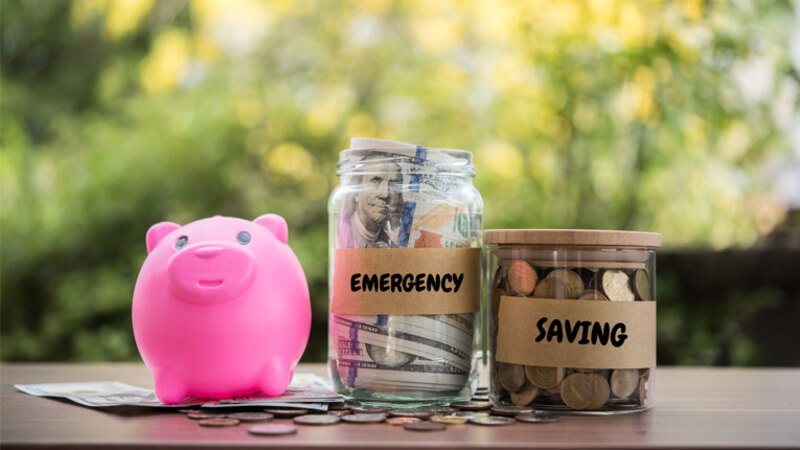
Wondering whether to focus on emergency fund vs debt payoff? This guide gives you the exact priority order for 2026, even on a tight income.
**📺 Watch the full video on our YouTube channel: https://youtu.be/sx5VeGebDWk
If you’re carrying debt and have almost nothing in savings, you’re facing one of the most common — and most stressful — money dilemmas in personal finance. Should you throw every dollar at your debt to save on interest? Or should you build a savings cushion first so that one unexpected expense doesn’t send you right back into more debt?
The answer isn’t either/or. The debate around emergency fund vs debt payoff has a specific, logical order that works for most people — and once you understand it, the decision becomes a lot less overwhelming. According to the Federal Reserve Bank of New York, Americans now carry $1.28 trillion in credit card debt, making this one of the most pressing financial decisions households face today. Here’s the exact sequence to follow in 2026.
Step 1: Build a $1,000 Buffer First — No Exceptions
Before you aggressively pay down any debt, save $1,000 in a separate savings account and do not touch it.
This isn’t a full emergency fund — it’s a buffer. Its job is to stop a minor emergency (a car repair, a medical bill, a busted appliance) from going straight onto a credit card and adding to your debt load.
Many people skip this step and pay the price. They make great progress on debt for two or three months, then an unexpected $700 expense wipes out their momentum and puts them deeper in the hole. The $1,000 buffer breaks that cycle.
Keep this money in a high-yield savings account, completely separate from your checking account. Out of sight, harder to spend.
When to Pause Debt Payoff and Build Savings
Once your $1,000 buffer is in place, the general rule is: aggressively pay down high-interest debt before building a larger emergency fund.
The math is clear — according to the Federal Reserve’s G.19 report, the average credit card APR for accounts accruing interest is 21.52%. When you’re paying that rate but only earning 4.5% in a high-yield savings account, every extra dollar in savings is costing you money in net terms.
However, there are situations where you should pause debt payoff and prioritize savings instead:
– Job instability. If there’s a real chance you could lose your income in the next 6–12 months, build savings first. Debt payments become unmanageable without income. – Medical vulnerability. If you or a dependent has unpredictable medical expenses, a slightly larger cash buffer makes more sense than textbook-perfect debt math. – Debt with low interest rates. If your only debt is a 4% car loan or a student loan at 5%, building your emergency fund simultaneously makes more financial sense.
Use judgment here. The math favors debt payoff; your real-life circumstances may shift that calculus.
The 3–6 Month Emergency Fund Target
Once your high-interest debt is cleared, your next financial priority is a full emergency fund: 3–6 months of essential living expenses, saved in a liquid, high-yield account.
To calculate your target: 1. Add up your monthly non-negotiables: rent/mortgage, utilities, groceries, transportation, minimum debt payments, insurance. 2. Multiply by 3 (minimum) or 6 (if you’re self-employed, have variable income, or work in a volatile industry).
For most Houston-area households, this lands somewhere between $8,000 and $20,000. That sounds like a lot, but you’re building it after clearing high-interest debt, so you’ll likely have significant monthly cash flow freed up by then.
Automate a fixed monthly transfer to this fund the same day your paycheck arrives. Treat it like a bill.
How to Handle Both Simultaneously on a Tight Income
If your income barely covers your expenses, you may feel like you can’t do either. Here’s a practical approach for tight budgets:
Split your extra dollar. If you can only free up $100/month beyond minimums, split it: $50 toward debt, $50 toward savings. Progress is slower, but you’re building both the financial and psychological muscle to manage money intentionally.
Use windfalls strategically. Tax refunds, bonuses, birthday money, and cash gifts should be split: 70% toward your highest-priority goal (usually debt), 30% toward savings. This creates momentum without sacrificing all liquidity.
Reassess every 90 days. Your income and expenses shift. Every quarter, look at your budget with fresh eyes and adjust the split. As you eliminate debts and free up minimums, you’ll naturally have more to allocate.
3 Common Mistakes to Avoid
Mistake 1: Investing before clearing high-interest debt. Earning 8–10% in the market while paying 20%+ on a credit card is a net loss. Pay off high-interest debt before investing (with the exception of getting your employer’s 401k match — always take free money).
Mistake 2: Using your emergency fund for non-emergencies. A sale at your favorite store is not an emergency. A weekend trip is not an emergency. Define clearly what qualifies — job loss, medical crisis, essential home or car repair — and stick to it.
Mistake 3: Building a huge emergency fund while carrying high-interest debt. Some people feel so anxious about having no savings that they build a $15,000 emergency fund while still carrying $20,000 in credit card debt at high interest rates. According to LendingTree’s credit card debt statistics, 47% of cardholders carry a balance every month — and at today’s rates, the math simply doesn’t favor holding large cash reserves while paying high-interest debt. The peace of mind isn’t worth the cost.
Final Thoughts
The right order is straightforward: $1,000 buffer first, then attack high-interest debt, then build your full 3–6 month emergency fund, then invest. If your debt carries low interest rates, it’s reasonable to build savings and pay debt simultaneously. If your income is tight, split your extra dollars intentionally and adjust every quarter.
The goal isn’t financial perfection — it’s a system that actually works for your real life. Subscribe to the Money Making Hints YouTube channel for practical, no-nonsense personal finance guidance every week, including deeper dives on budgeting, debt payoff, and building your first investment portfolio.
Recommended resources:
Robinhood — free investing app, great for when you’re ready to invest after clearing high-interest debt.
**📺 More videos on our YouTube channel: https://www.youtube.com/@MoneyMakingHints
📥 Free Download: Get the free Debt Payoff Calculator & Checklist — the 4-step worksheet that shows you the exact sequence covered in this post.
🔗 Related posts: best high-yield savings account for your emergency fund | paying off debt aggressively
FTC Disclosure: This post contains affiliate links. If you click and make a purchase, I may earn a small commission at no extra cost to you. I only recommend products I genuinely believe in.
The information in this article is for educational purposes only and is not personalized financial advice. Always do your own research before making financial decisions. Brand names mentioned are for informational purposes only — not sponsored by or affiliated with any mentioned companies.